

Key Takeaways
Q1: What is “How Can Employers Explain EPF How to Withdraw for Foreign Workers Clearly With 5 Simple Steps?” and why does it matter?
It is a practical employer guide for explaining EPF withdrawal categories, documents, channels, and follow-up steps to foreign workers, which matters because HR clarity reduces payroll confusion, compliance mistakes, and avoidable delays in Malaysia.
Q2: How does epf how to withdraw work for foreign workers in Malaysia?
For most foreign workers, the process starts by identifying the correct withdrawal type, such as Leaving Country Withdrawal or Akaun Fleksibel withdrawal, then checking eligibility, preparing supporting documents, and submitting through KWSP’s approved online or manual channels.
Q3: What should employers do next after learning epf how to withdraw?
Employers should create a simple internal SOP, brief HR and payroll staff, verify worker documents early, and direct staff to the correct KWSP channel, especially because non-Malaysian employees may face specific verification limits or office-visit requirements.
EPF how to withdraw is a question many employers in Malaysia need to answer carefully, especially when foreign workers ask whether they can access EPF savings before leaving the country, during employment, or for approved account-based purposes.
For SMEs, startups, and companies without a full in-house HR department, understanding epf how to withdraw is not only an employee communication issue. It can also affect payroll coordination, document handling, employee exit management, and overall HR compliance.
In practice, employers often face the same problems: staff do not know which EPF account applies, they confuse full withdrawal with partial withdrawal, or they assume every request can be completed online without verification.
Current KWSP guidance shows that foreign workers returning to their home country may apply for Leaving Country Withdrawal to withdraw all EPF savings, while Akaun Fleksibel (Account 3) withdrawals are also available under specific rules, including online limits for non-Malaysian employees.
This is where structured HR support matters. MUSTRE operates in Shah Alam as an HR outsourcing and consulting partner for Malaysian businesses that need stronger payroll, compliance, recruitment, and employee management systems.
That positioning is reflected in client feedback such as
Amir Munzir Mohd Salleh’s note that outsourcing HR helped his SME focus on core operations, and Dahlia Naz’s testimonial that MTR helped complete an updated employee handbook based on the 2024 Act.
Hire us!
Elevate your business with tailored HR solutions, including compliance, talent acquisition, culture building, and streamlined processes. Unlock success today!

These examples reinforce a practical point: when employers explain statutory processes such as EPF how to withdraw clearly, employee management can become more organized and less reactive.
This article breaks the topic into 5 simple steps so employers can explain EPF withdrawal options for foreign workers with greater accuracy, fewer misunderstandings, and better HR control.
What Does EPF How to Withdraw Mean for Foreign Workers in Malaysia?
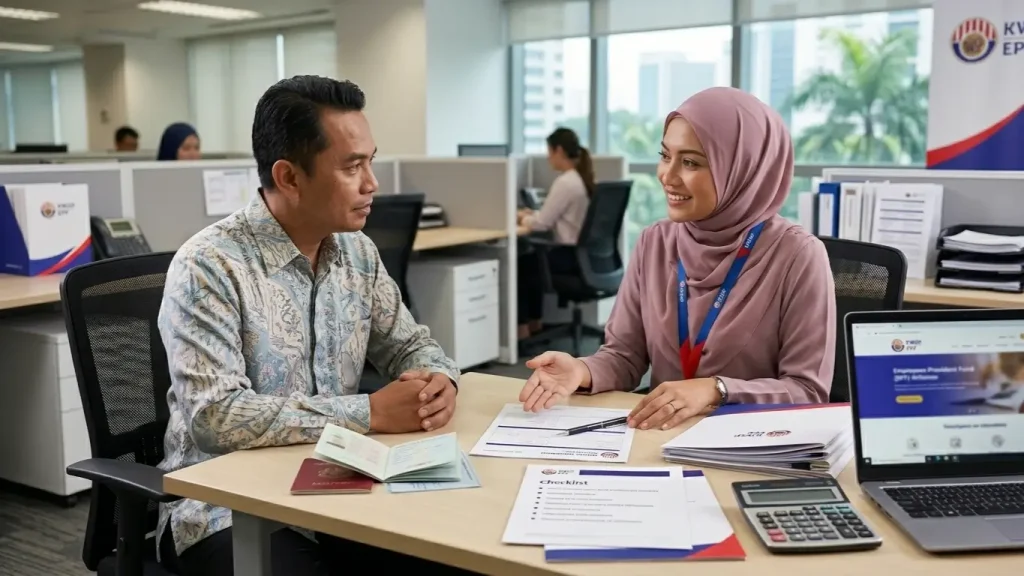
Employers can explain EPF how to withdraw for foreign workers by matching the employee’s circumstances with the correct KWSP withdrawal category, required evidence, submission channel, and verification process.
Why Employers Need to Explain KWSP Withdrawal Clearly to Foreign Workers
Clear employer guidance on KWSP withdrawal matters because foreign workers often depend on HR, payroll, or administrative staff to understand KWSP categories, document requirements, and whether a withdrawal request can be submitted online or must be handled manually.
For SMEs and startups, KWSP withdrawal can affect more than employee benefits. It may influence final payroll arrangements, work pass timing, departure planning, employee communication, and HR administration. When employers give vague answers, workers may submit the wrong request, miss required evidence, or assume that every EPF transaction is fully digital.
EPF Withdrawal Malaysia: Who Qualifies as a Foreign Worker?
For EPF withdrawal Malaysia cases involving foreign workers, eligibility depends on factors such as whether the worker is returning to their home country, remains employed, qualifies under a particular account, or meets the requirements of a specific withdrawal category.
KWSP states that expatriates, permanent residents, and foreign workers returning to their home country can choose to withdraw all EPF savings under Leaving Country Withdrawal. That is the clearest full-withdrawal pathway employers should explain in exit-related cases.
EPF How to Withdraw for Employees Returning to Their Home Country
Foreign workers returning permanently to their home country can generally be guided toward Leaving Country Withdrawal, which is the clearest full-withdrawal route employers should explain during exit planning and final HR documentation.
Employers should explain that this is not the same as a normal partial withdrawal. It is usually tied to the worker’s departure from Malaysia, so HR should help check passport details, employment end records, bank account readiness, and any supporting documents needed before the employee starts the application.
EPF Withdraw: What Options Apply to Workers Still Employed in Malaysia?
When employees ask about EPF withdraw options while they are still employed, HR should first determine whether the request falls under Account 2, Account 3, or another permitted withdrawal category.
When explaining EPF how to withdraw in this situation, employers should first identify the purpose of the withdrawal and then match it with the relevant account and current KWSP requirements. This helps prevent confusion between flexible access, approved-purpose withdrawals, and full Leaving Country Withdrawal.
Which EPF Accounts Should Employers Explain Before Any Withdrawal?
Employers should explain Account 1, Account 2, and Account 3 before discussing EPF how to withdraw because the correct withdrawal route depends on the account involved, the employee’s purpose, and the applicable eligibility requirements.
What Employers Should Know About Account 1, Account 2, and Account 3
Each EPF account serves a different savings purpose. Employers should therefore avoid simply telling workers that they can “withdraw EPF” without first determining which account applies. Understanding the account structure also makes EPF how to withdraw easier for employees to understand.
Account 3, also known as Akaun Fleksibel, is meant for more accessible savings and can be withdrawn when the account has at least RM50. Payments, once processed and approved, are credited directly into the member’s bank account, making this the most practical partial-withdrawal example for employers to explain.
How to Withdraw EPF Account 2 for Approved Needs
Employers should explain that Account 2 withdrawals are usually tied to specific approved purposes, so foreign workers should not assume they can use this account freely for any personal financial need.
When HR explains EPF how to withdraw from Account 2, the safer approach is to identify the employee’s reason first and determine whether it fits a recognized withdrawal category. This reduces document mistakes and prevents employers from giving employees unrealistic expectations about approval.
How EPF Account 3 Withdrawal Works for Flexible Access
Account 3 offers more flexible access compared with more restricted EPF accounts. When explaining EPF how to withdraw through Account 3, employers should still remind foreign workers that flexible access does not mean unlimited access.
For foreign workers, this explanation must still come with caution. HR should remind employees that flexible access does not mean unlimited access, because eligibility, minimum balance, transaction limits, and verification requirements can still affect whether the withdrawal is processed smoothly.
Why Account Type Matters Before Starting Any EPF Withdrawal Request
Account type matters because the wrong category leads to the wrong form, wrong expectation, and wrong supporting documents, which can delay processing and create unnecessary HR back-and-forth.
This becomes particularly important when a foreign worker says that the savings are required for “personal use.” Employers should not automatically treat personal use as a valid withdrawal category. Instead, HR should determine whether the employee’s request fits Account 3, an approved Account 2 purpose, Leaving Country Withdrawal, or another applicable route. A clear understanding of the account structure makes EPF how to withdraw easier to explain accurately.
How Does EPF Account 3 Withdrawal Affect Foreign Workers?

EPF Account 3 withdrawal gives foreign workers a flexible option in certain cases, but employers must explain the transaction limits and channel restrictions that may apply to non-Malaysian members.
What Is EPF Account 3 Withdrawal and When Can It Be Used?
EPF Account 3 withdrawal allows eligible members with savings in Akaun Fleksibel to withdraw at any time, subject to minimum balance and channel conditions set by KWSP.
KWSP states that an Akaun Fleksibel withdrawal can be made when the account meets the required minimum savings threshold. When explaining EPF how to withdraw through Account 3, employers should also remind workers that the application must still pass the required verification process.
EPF How to Withdraw Through Account 3 for Non-Malaysian Employees
Employers explaining EPF how to withdraw through Account 3 should tell non-Malaysian employees to confirm their account status, identification records, available balance, and permitted submission method before applying.
This is where HR communication must stay precise. Foreign workers should be told to verify their eligibility first, use the correct EPF channel, and prepare for possible extra verification if the application cannot be completed smoothly through the standard digital process.
Minimum Amount, Eligibility, and Withdrawal Channels
Minimum amount, eligibility, and withdrawal channel are the three checks employers should explain first because they determine whether an Account 3 request can proceed quickly or needs further review.
Following this structure makes EPF how to withdraw easier to communicate and can reduce avoidable application errors.
When Employers Should Recommend Account 3 Instead of Other Withdrawal Options
Employers should mention Account 3 when the worker is not leaving Malaysia permanently, needs flexible access to eligible savings, and meets the current account and verification requirements.
At the same time, employers must explain a crucial limitation: KWSP says online applications for non-Malaysian employees are limited to a maximum of RM3,000 per transaction for Akaun Fleksibel, and other cases may require manual counter handling.
Can Foreign Workers Use EPF Withdrawal for Personal Use?
Employees who ask whether they can withdraw money from KWSP should first understand that access depends on their EPF account, withdrawal category, eligibility, and current employment or departure status.
What EPF Withdrawal for Personal Use Really Means
EPF withdrawal for personal use usually means the worker wants accessible funds, but employers should translate that request into a compliant category such as Account 3 access or an approved Account 2 purpose.
When explaining EPF how to withdraw, employers should avoid promising approval based only on the employee’s personal reason. Instead, HR should check why the employee wants to withdraw, which EPF account is involved, whether the employee meets the eligibility conditions, what supporting documents are required, and which submission channel applies.
How Employers Can Avoid Giving Misleading Advice About Personal Use
Employers can avoid misleading advice by using a checklist that separates withdrawal reason, EPF account, submission channel, and required documents before giving any answer to the employee.
Employers can explain EPF how to withdraw clearly through five steps: confirm the reason, identify the correct category, prepare the required documents, submit through the correct channel, and track the application until completion. MUSTRE presents itself as a provider of HR management, payroll management, and consultation services for smoother company operations.
What Are the 5 Simple Steps Employers Can Use to Explain EPF How to Withdraw?
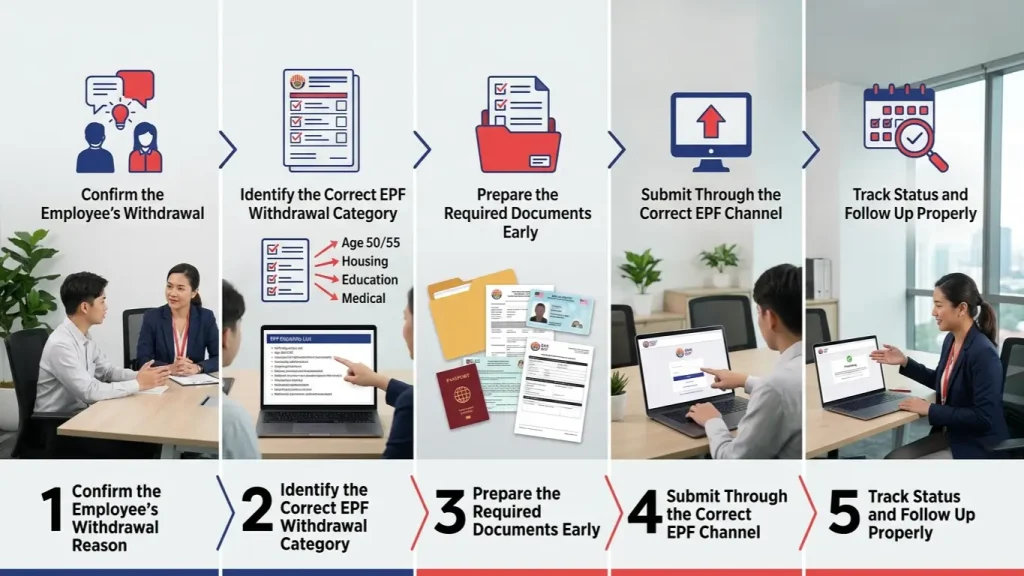
Employers can explain EPF withdrawal clearly by using a five-step method: confirm the reason, identify the category, prepare documents, submit through the right channel, and track the status until completion.
Step 1: Confirm the Employee’s Withdrawal Reason
The first step in EPF how to withdraw is to confirm exactly why the worker wants access to the savings. The reason helps determine whether the case involves Leaving Country Withdrawal, Account 2, Account 3, or another eligible category.
Step 2: Identify the Correct EPF Withdrawal Category
The second step is to classify the request accurately. Full withdrawal, partial withdrawal, Account 2 withdrawal, Account 3 withdrawal, and Leaving Country Withdrawal should not be treated as the same process. Correct classification makes the remaining EPF how to withdraw process easier for both the employee and the HR team.
Step 3: Prepare the Required Documents Early
The third step is to collect identity, work-pass, banking, and purpose-based documents early, because incomplete evidence is one of the most preventable sources of delay.
Step 4: Submit Through the Correct EPF Channel
The fourth step in EPF how to withdraw is to use the correct submission channel. Depending on the withdrawal type and employee eligibility, this may involve the KWSP i-Akaun application, member portal, or a physical EPF office.
Step 5: Track Status and Follow Up Properly
The final EPF how to withdraw step is to monitor the application until a decision or further instruction is received.
What Documents Are Required for EPF Withdrawal by Foreign Workers?
Foreign workers normally need identity, banking, and withdrawal-specific supporting documents. The exact documents required for EPF how to withdraw depend on the type of application and the employee’s circumstances.
Basic Documents Employers Should Ask Workers to Prepare
Basic preparation may include passport details, bank account information, EPF membership details, employment information, and relevant identification records. For EPF withdrawal Malaysia applications involving foreign employees, employers should also consider whether additional supporting records are required due to the worker’s immigration, employment, or departure status.
Additional Documents Based on the Withdrawal Type
Additional documents depend on the withdrawal type, so employers should not recycle one checklist for every request involving foreign staff.
For example, leaving-country applications may require supporting proof linked to nationality, exit status, or passport record differences, while account-based withdrawals depend more on eligibility and transaction conditions.
This is why employers should not use one document checklist for every KWSP withdrawal case. A category-specific checklist makes EPF how to withdraw easier for employees to follow and reduces repeated HR enquiries.
What Common EPF Withdrawal Mistakes Should Employers Help Foreign Workers Avoid?

The most common mistakes are confusing account types, assuming everything can be done online, and submitting incomplete documents without checking the exact KWSP route first.
Confusing Full Withdrawal, Account 2, and Account 3
Employers should correct this misunderstanding before an application begins. Full withdrawal and partial withdrawal have different eligibility requirements, purposes, and procedures. A worker who understands EPF how to withdraw should first know which category applies instead of simply asking to withdraw all available savings.
Assuming Every Request Can Be Approved Online
Employers should not promise that every KWSP withdrawal request can be completed digitally. Some foreign workers may face additional verification requirements or may need to complete certain applications through an EPF office.
When employees ask about EPF withdraw procedures, HR should explain that the correct submission method depends on the withdrawal category and the employee’s circumstances.
The key is to match the worker’s situation to the correct withdrawal category, explain the right account clearly, prepare the required documents early, and set realistic expectations about online limits and verification.
When HR communication is structured, employers can reduce confusion, improve administrative control, and help employees handle EPF matters with greater confidence. A clear internal procedure for EPF how to withdraw ultimately gives both employers and foreign workers a more organized way to manage EPF withdrawal enquiries.
If your company needs clearer support for foreign worker HR processes, payroll coordination, and statutory communication, MUSTRE can help you organize these issues more professionally.
From day-to-day HR administration to expatriate-related documentation support, MUSTRE gives SMEs and growing businesses a more structured way to manage staff matters.
Explore Commercial Officer Hiring Services to see how your team can handle employer obligations with less confusion and better control.
FAQ
How to withdraw EPF savings online in Malaysia
Employers should explain that online EPF withdrawal depends on the withdrawal category, the employee’s eligibility, and whether the worker can use the official EPF digital channel for that specific request.
For foreign workers, this is especially important because not every case is fully online from start to finish. The best approach is to confirm the reason for withdrawal first, then guide the worker to the right EPF channel, prepare documents early, and remind them that some cases may still require additional verification.
What documents are required to withdraw EPF funds
The required documents usually depend on the withdrawal type, but employers should start with a practical checklist that includes identity details, passport information, bank account details, and any supporting records tied to the employee’s request.
If the foreign worker is leaving Malaysia, the case may need additional proof connected to departure or status changes.
A simple HR checklist reduces delays, helps payroll teams stay aligned, and avoids repeated back-and-forth with employees.
EPF withdrawal process for foreigners working in Malaysia
The EPF withdrawal process for foreigners working in Malaysia should be explained in a sequence that is easy for employees to follow. First, confirm why the worker wants to withdraw.
Next, identify whether the request involves full withdrawal, Account 2, or Account 3.
Then prepare the documents, choose the right submission channel, and follow up on the application status.
This step-by-step explanation helps employers avoid giving unclear advice and helps workers understand what to expect.
How to track EPF withdrawal status online
Employers should tell workers to monitor their withdrawal status through the official EPF channel used for the submission, while also reminding them that not every delay means a rejection.
Status checks are useful because they help employees confirm whether the application is being processed, pending verification, or needs additional action.
For HR teams, encouraging workers to check status properly can reduce unnecessary follow-up questions and keep communication more organized.
Differences between full and partial EPF withdrawal options
Full and partial EPF withdrawals should never be explained as if they are the same process.
Full withdrawal is generally linked to a major status-based event, such as a foreign worker returning to the home country, while partial withdrawal is usually tied to specific accounts and approved access conditions.
Employers who explain this difference clearly will help staff avoid choosing the wrong route and improve the quality of supporting documents from the start.