

Key Takeaways
Q1: What are 12 acceptable reasons for emergency leave examples for employees, and why does it matter to SMEs?
Acceptable emergency leave reasons include sudden illness, family medical crisis, death, accident, childcare emergency, home damage, natural disaster, legal obligation, transport disruption, and other urgent situations affecting work attendance.
Q2: How does a reason for emergency leave help employers make better HR decisions?
A clear reason for emergency leave helps employers assess urgency, request reasonable documentation, manage payroll records, arrange work coverage, and apply company policy consistently across employees.
Q3: What should SME employers do next to manage emergency leave properly?
SME employers should create a written emergency leave policy, define acceptable reasons, document approval procedures, clarify paid or unpaid treatment, and keep proper records for HR compliance and payroll accuracy.
Reason for emergency leave is one of the most common HR issues faced by SMEs because employees may suddenly be unable to attend work due to illness, family emergencies, accidents, bereavement, home damage, or urgent personal crises.
For employers, the challenge is not only whether to approve the leave, but how to handle it fairly, consistently, and in line with company policy.
In Malaysia, emergency leave is usually managed through internal HR policy, employment contract, employee handbook, or management discretion.
This makes it especially important for SMEs, startups, and growing companies to have clear rules on what qualifies as an emergency, what documents may be required, and whether the leave is treated as paid leave, unpaid leave, sick leave, compassionate leave, or deducted from annual leave.
For businesses without a full in-house HR department, unclear emergency leave practices can create payroll errors, staff dissatisfaction, operational disruption, and potential compliance risks.
A properly structured emergency leave policy helps employers protect business continuity while still responding with empathy when employees face genuine urgent situations.
Hire us!
Elevate your business with tailored HR solutions, including compliance, talent acquisition, culture building, and streamlined processes. Unlock success today!

This is why companies working with professional HR support often experience smoother employee management.
For example, Noor Ariffshah shared that MUSTRE’s HR services significantly reduced the burden of managing staff and HR matters, allowing him to focus fully on running the business.
Similarly, Amir Munzir Mohd Salleh noted that outsourcing HR to MTR Solutions helped his SME focus on core operations while leaving complex HR matters to experts.
This article explains 12 acceptable emergency leave examples, how employers should assess each situation, what proof may be requested, and how SMEs can create better emergency leave rules for a more structured, compliant, and employee-friendly workplace.
What Does Reason for Emergency Leave Mean in the Workplace?

A reason for emergency leave refers to a sudden, urgent, and unavoidable situation that prevents an employee from attending work or continuing normal duties responsibly.
Why Emergency Leave Is Different from Annual Leave, Sick Leave, and Compassionate Leave
Emergency leave is different because it usually happens without advance notice, while annual leave is planned, sick leave is medical-based, and compassionate leave often relates to bereavement.
Emergency Leave Is Usually Sudden, Urgent, and Unplanned
Emergency leave normally involves circumstances that happen unexpectedly and require immediate personal attention. For example, an employee may face a road accident, hospitalisation of a parent, sudden childcare issue, or serious home damage.
The Situation Normally Requires Immediate Attention
The urgency is what separates emergency leave from normal personal leave. If the situation can reasonably be planned earlier, employers may ask the employee to apply for annual leave instead.
Examples Include Accident, Hospitalisation, Death, or Home Emergency
Common examples include a car accident, emergency admission to hospital, death of a close family member, house break-in, burst pipe, flood damage, or a child suddenly falling ill.
Why the Reason for Emergency Leave Matters to SMEs
SMEs need a clear reason for emergency leave because it helps employers approve leave fairly, maintain payroll accuracy, and reduce unnecessary disputes between staff and management.
Clear Reasons Help Employers Make Fair Leave Decisions
Without proper reasons, emergency leave approval can become inconsistent. One manager may approve the request, while another may reject a similar case. This can create employee dissatisfaction and claims of unfair treatment.
SMEs Need Proper Records for HR, Payroll, and Compliance
A proper leave record helps the company track attendance, calculate salary correctly, review leave patterns, and support HR decisions if employment issues arise later.
Written Policies Reduce Confusion Between Employees, Managers, and HR Teams
When emergency leave rules are documented, employees know how to report emergencies, managers know how to approve requests, and HR can process records more confidently.
Is Emergency Leave Required by Law in Malaysia?
Emergency leave is generally not listed as a fixed statutory entitlement under Malaysian employment practice, so employers normally manage it through policy, contract, or HR discretion.
What Employers Should Know About the Employment Act 1955
The Employment Act 1955 sets important employment standards, but emergency leave is usually handled separately through company rules, employee handbook terms, or internal HR procedures.
Emergency Leave Is Usually Managed Through Company Policy or Employment Contract
Because emergency leave treatment can differ between companies, SMEs should clearly define whether emergency leave is paid, unpaid, replaced with sick leave, or deducted from annual leave.
Employers Should State Whether It Is Paid, Unpaid, or Deducted from Annual Leave
This prevents confusion during payroll processing. For example, if an employee takes one day emergency leave, HR must know whether salary remains unchanged or whether leave balance is affected.
Clear Leave Rules Help Malaysian SMEs Avoid HR and Payroll Disputes
When rules are unclear, employees may assume emergency leave is paid, while employers may treat it as unpaid. This can lead to unnecessary conflict. For SMEs that need structured policy support, HR Consultation Services can help employers create clearer leave rules and reduce HR confusion.
Can Employers Decide Their Own Emergency Leave Policy?
Employers can usually create their own emergency leave policy, provided it is reasonable, clearly communicated, and applied consistently across employees.
Company Policy Should Define Approval Rules and Leave Treatment
A good policy should explain what counts as an emergency, who the employee must notify, what documents may be required, and how the leave will be recorded.
HR Should Explain Accepted Reasons, Documentation, and Reporting Channels
For SMEs, the reporting process should be simple. Employees may be required to inform their immediate supervisor, HR officer, or business owner through WhatsApp, email, phone call, or HR software.
This Can Be Included in the Employee Handbook or HR Policy Manual
A written employee handbook helps new and existing staff understand emergency leave rules before a problem happens.
Can Emergency Leave Be Deducted from Annual Leave?
Emergency leave may be deducted from annual leave if the company policy clearly allows it and the decision is applied fairly.
Annual Leave Deduction Depends on Written Company Policy
If the policy says emergency leave will be treated as annual leave after approval, employees should be informed before payroll is processed.
Employers Should Communicate This Clearly Before Disputes Happen
Clear communication is important because employees may feel unfairly treated if they only discover the deduction after checking their payslip or leave balance.
Consistent HR Practice Protects Both Employer and Employee
Consistency helps employers defend their decisions and helps employees understand what to expect during urgent personal situations.
What Are 12 Acceptable Reasons for Emergency Leave Examples for Employees?
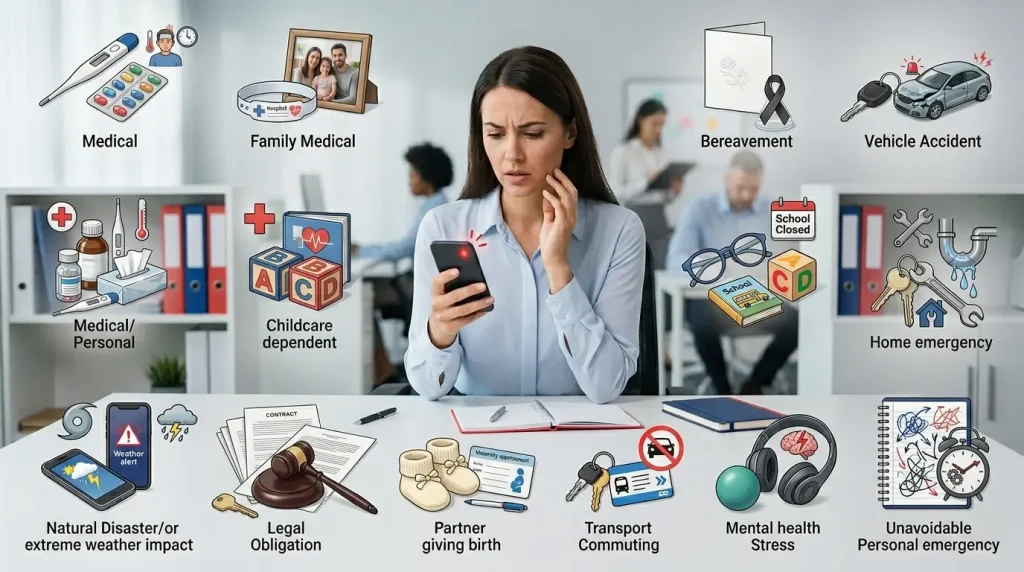
The most acceptable emergency leave examples usually involve sudden medical, family, safety, legal, transport, or unavoidable personal situations that affect an employee’s ability to work.
1. Sudden Personal Illness
Sudden personal illness may justify emergency leave when the employee becomes unfit to work and needs immediate rest, treatment, or medical attention.
Sudden Illness Can Be a Valid Reason for Emergency Leave
Examples include high fever, food poisoning, severe migraine, asthma attack, or contagious illness. In these cases, forcing the employee to work may affect productivity and workplace safety.
Employees May Need Immediate Rest, Treatment, or Medical Consultation
If the illness is serious, HR may ask for a medical certificate or clinic record after the employee receives treatment.
Examples Include High Fever, Food Poisoning, Severe Migraine, or Contagious Illness
These conditions can happen suddenly and may make it unreasonable for the employee to travel to work or continue duties.
2. Medical Emergency Involving a Close Family Member
A family medical emergency may qualify when an employee must assist a spouse, child, parent, or dependent who needs urgent care.
Employees May Need Leave to Support an Immediate Family Member
This is common when a child is admitted to hospital, a parent collapses, or a spouse requires emergency treatment.
Employers Should Consider Urgency and Caregiving Responsibility
SMEs should assess whether the employee is the only available caregiver or whether the emergency directly requires their presence.
Examples Include Parent Hospitalisation, Child Illness, or Emergency Surgery
Supporting documents may include hospital admission records, appointment slips, or a short explanation from the employee.
3. Death of a Close Family Member
Death of a close family member is a strong reason for emergency leave because the employee may need time for funeral arrangements and family responsibilities.
Bereavement Situations Require Compassionate and Immediate Handling
Employers should handle death-related leave requests sensitively. Depending on company policy, it may be recorded as compassionate leave or emergency leave.
Employers May Classify This as Compassionate Leave or Emergency Leave
The classification depends on the company handbook. However, the response should remain professional, respectful, and humane.
Examples Include Death of Parent, Spouse, Child, Sibling, or Close Dependent
Some companies may request a funeral notice or death certificate, but HR should avoid making the process unnecessarily difficult.
4. Accident on the Way to Work or Outside Work
An accident is a valid reason for emergency leave when it prevents the employee from reaching work or performing duties safely.
An Accident Can Prevent the Employee from Attending Work Safely
Road accidents, motorcycle crashes, workplace-related injuries, or falls can require immediate medical treatment, police reporting, insurance handling, or vehicle recovery.
Supporting Documents May Include Medical Notes, Police Reports, or Insurance Records
Employees may not be able to submit documents immediately, so HR should allow reasonable time after the emergency is controlled.
Examples Include Car Accident, Motorcycle Accident, or Serious Injury
The focus should be on safety first, followed by proper documentation once the employee is stable.
5. Childcare or Dependent Care Emergency
Childcare or dependent care emergencies may justify leave when a sudden care issue prevents the employee from attending work responsibly.
Sudden Care Disruption Can Affect the Employee’s Ability to Work
Examples include a child suddenly becoming sick, school closure, nursery emergency, or caregiver cancellation at the last minute.
Employers Should Assess Whether the Situation Is Urgent and Unavoidable
The key question is whether the employee had a realistic alternative arrangement or whether immediate presence was necessary.
Examples Include Sick Child, School Emergency, or Caregiver Suddenly Unavailable
For SMEs, flexible arrangements such as half-day leave or remote work may sometimes solve the issue.
6. Home Emergency Requiring Immediate Attention
A home emergency may qualify when property damage, safety risk, or urgent repair prevents the employee from leaving home.
Serious Home Damage or Safety Risk Can Justify Emergency Leave
Examples include burst pipe, electrical hazard, break-in, fire, flood, roof leak, or gas-related danger. These situations may require the employee to contact authorities or repair teams.
The Issue Should Require Immediate Action from the Employee
Routine maintenance, scheduled repairs, or non-urgent household matters should not usually be treated as emergency leave.
Examples Include Burst Pipe, Fire, Flood, Break-In, or Electrical Hazard
Where possible, employees should provide photos, repair reports, police reports, or short written explanations.
7. Natural Disaster or Extreme Weather Impact
Natural disasters or extreme weather may justify emergency leave when travel, safety, property, or family protection is directly affected.
Floods, Storms, or Road Closures Can Make Work Attendance Unsafe
In Malaysia, floods and severe storms can disrupt commuting and damage homes. Employers should consider real travel conditions before deciding attendance expectations.
Employers Should Consider Local Safety Conditions and Travel Disruptions
If roads are closed or public transport is disrupted, late arrival, remote work, or emergency leave may be more reasonable than disciplinary action.
Examples Include Flooded Routes, Evacuation Orders, or Property Damage
Employees should update employers as soon as possible and share basic proof where available.
8. Urgent Legal or Government-Related Obligation
Urgent legal or government matters may qualify when the employee is required to attend immediately and cannot reschedule the obligation.
Official Summons or Legal Obligations May Require Immediate Attendance
Examples include police matters, court summons, immigration issues, official government notices, or urgent documentation involving family or dependents.
HR Should Request Reasonable Documentation Where Available
A summons, official letter, police report, or government appointment notice can help verify the request.
Examples Include Police Report, Court Summons, or Government Office Requirement
If the matter was known earlier, employers may classify it as annual leave rather than emergency leave.
9. Partner Giving Birth or Pregnancy-Related Emergency
Pregnancy-related urgency may justify emergency leave when the employee must support a spouse or immediate family member during a sudden medical situation.
Pregnancy-Related Urgency May Require Immediate Employee Support
Examples include spouses going into labour unexpectedly, pregnancy complications, emergency hospital admission, or urgent medical consultation.
Employers Should Handle These Requests with Care and Sensitivity
Pregnancy-related situations often involve emotional stress and medical risk, so HR should balance documentation requirements with compassion.
Examples Include Spouse in Labour or Pregnancy Complication
Depending on company policy, this may be recorded as emergency leave, paternity-related leave, annual leave, or unpaid leave.
10. Transport Breakdown or Serious Commuting Disruption
Transport breakdown may justify emergency leave when the employee cannot reasonably reach the workplace despite genuine effort.
Serious Travel Disruption Can Prevent the Employee from Reaching Work
Examples include vehicle breakdown, major road accident, public transport cancellation, or traffic disruption caused by emergency conditions.
Employers Can Consider Late Arrival, Remote Work, or Emergency Leave
Not every transport issue requires a full day of leave. HR may approve late arrival, half-day leave, or remote work depending on the role.
Examples Include Vehicle Breakdown, Major Accident, or Public Transport Disruption
Employees should notify the employer quickly and provide updates if the delay becomes longer than expected.
11. Mental Health Crisis or Severe Emotional Distress
A serious mental health crisis may justify emergency leave when the employee is temporarily unfit to work safely or effectively.
A Serious Mental Health Episode Can Affect Work Readiness and Safety
Examples include panic episodes, severe anxiety attacks, burnout crisis, grief shock, or emotional distress after a traumatic incident.
Employers Should Respond Privately, Respectfully, and Without Stigma
HR should avoid public discussion, insensitive remarks, or excessive questioning. Where necessary, the employee may be guided to proper medical or counselling support.
Examples Include Panic Episode, Burnout Crisis, or Sudden Emotional Breakdown
For SMEs, manager training is important so mental health-related requests are handled professionally and confidentially.
12. Other Sudden and Unavoidable Personal Emergency
Some genuine emergencies may not fit standard categories but can still be valid when urgency, evidence, and work impact are clear.
Genuine Emergencies May Not Always Fit Standard Categories
Examples may include urgent safety threats, immediate family crisis, sudden travel need due to disaster, or unexpected event involving a dependent.
Employers Should Assess Context, Urgency, Evidence, and Work Impact
Rather than rejecting unusual cases automatically, HR should review whether the employee had control over the situation and whether immediate absence was necessary.
Examples Include Sudden Safety Risk, Family Crisis, or Emergency Travel Need
A flexible but documented approach helps employers stay fair while preventing abuse.
What Reasons Are Usually Not Acceptable for Emergency Leave?
Reasons that are planned, avoidable, minor, or unsupported are usually not acceptable as emergency leave because they do not meet the standard of urgency.
Pre-Planned Personal Events
Pre-planned personal events should normally be handled through annual leave because the employee has enough time to apply earlier.
Planned Events Should Normally Use Annual Leave
Examples include holidays, weddings, personal appointments, family gatherings, or errands known in advance. These are not emergencies simply because the employee forgot to apply earlier.
Employees Should Apply Earlier When the Event Is Known in Advance
Employers should remind employees to follow the proper leave application timeline.
Examples Include Holiday, Wedding Attendance, Family Dinner, or Personal Errand
A clear leave calendar and approval workflow can reduce last-minute requests.
Minor Illness Without Urgency
Minor discomfort may not qualify as emergency leave if the employee can still work or follow normal sick leave procedures.
Not Every Discomfort Qualifies as Emergency Leave
A mild headache, tiredness, or non-urgent clinic visit may not justify emergency leave unless the situation becomes serious.
Employees Should Follow Sick Leave Procedures Where Appropriate
If medical treatment is needed, sick leave with a medical certificate may be more suitable.
Examples Include Mild Headache or Non-Urgent Clinic Visit
Employers should avoid harsh assumptions but still apply proper leave categories.
Repeated Last-Minute Leave Without Clear Explanation
Repeated last-minute emergency leave may require HR review when the reasons are unclear, unsupported, or show suspicious patterns.
Frequent Patterns May Require HR Review
For example, repeated emergency leave on Mondays, Fridays, paydays, or after public holidays may indicate a pattern that needs discussion.
Employers Should Investigate Fairly Before Taking Action
HR should speak privately with the employee before making conclusions because the pattern may involve family care, illness, burnout, or personal difficulties.
Examples Include Repeated Monday or Friday Emergency Leave Requests
A documented counselling session may help clarify expectations.
Personal Matters That Could Have Been Planned Earlier
Personal matters that were known in advance should not automatically become emergency leave due to poor planning or late notice.
Poor Planning Should Not Automatically Become Emergency Leave
Examples include scheduled appointments, known legal matters, planned travel, or administrative tasks that could have been arranged outside working hours.
HR Should Separate Genuine Crisis from Avoidable Scheduling Issues
This protects company operations while still allowing compassion for true emergencies.
Examples Include Planned Court Matter, Routine Appointment, or Administrative Task
Employers should define these examples clearly in the leave policy.
How Should Employees Request Emergency Leave Professionally?

Employees should request emergency leave quickly, honestly, and clearly so employers can assess urgency, arrange coverage, and record the leave correctly.
Inform the Employer as Soon as Possible
Employees should notify the employer immediately once they know they cannot attend work or continue their duties due to an emergency.
Early Notification Helps the Company Manage Work Disruption
A fast update allows managers to reassign tasks, adjust schedules, inform clients, or arrange temporary backup support.
Employees Should Use the Company’s Approved Communication Channel
The approved channel should be stated in the employee handbook or HR policy.
Examples Include WhatsApp, Phone Call, HR System, or Email
For urgent cases, a phone call or WhatsApp message may be practical, followed by formal HR submission later.
Give a Clear but Concise Explanation
Employees should explain the emergency clearly without sharing unnecessary private details that are not relevant to the leave decision.
Employees Do Not Need to Overshare Private Details
A professional message should mention the type of emergency, expected absence duration, and whether the employee will provide updates.
The Message Should Explain the Urgency and Expected Absence
This helps the employer decide whether emergency leave, sick leave, unpaid leave, or annual leave is appropriate.
Example: “I have a family medical emergency and need emergency leave today.”
Simple, respectful communication can prevent misunderstanding.
Estimate the Duration of Leave
Employees should estimate how long they may be away so the employer can manage staffing and work commitments.
Employers Need to Plan Team Coverage
Even if the exact duration is uncertain, employees should give the best available estimate and update HR when the situation changes.
Employees Should Update HR if the Situation Changes
If one day becomes two days, the employee should not wait until the next working day to inform management.
Examples Include Half-Day, One Day, or Pending Further Update
This keeps the company informed and reduces operational disruption.
Provide Supporting Documents Where Reasonable
Supporting documents help employers verify emergency leave requests and maintain accurate HR, payroll, and compliance records.
Proof Helps Prevent Misuse and Protects HR Records
Proof should be reasonable and relevant to the emergency, not excessive or invasive.
Documents Should Match the Nature of the Emergency
For example, a medical emergency may require a medical certificate, while a house break-in may require a police report.
Examples Include Medical Certificate, Police Report, Death Certificate, or Official Notice
HR should allow documents to be submitted after the urgent situation is settled.
How Should Employers Handle Emergency Leave Requests Fairly?
Employers should handle emergency leave by combining compassion, consistency, documentation, and business continuity planning.
Set a Clear Emergency Leave Policy in the Employee Handbook
A clear emergency leave policy gives employees and managers a practical standard for deciding what qualifies, how to apply, and what proof is required.
The Policy Should Define Acceptable Reasons and Approval Steps
The policy should list common acceptable and non-acceptable examples, notification channels, approval authority, document requirements, and payroll treatment.
This Reduces Confusion Between Employees and Managers
Clear policies are especially useful for SMEs where business owners or supervisors often handle HR matters directly.
Include Paid, Unpaid, Annual Leave Deduction, and Documentation Rules
This helps payroll teams process salary and leave balance accurately.
Apply the Policy Consistently Across Employees
Consistent policy application helps prevent unfair treatment, employee dissatisfaction, and claims of favouritism in emergency leave decisions.
Inconsistent Approval Can Create Workplace Conflict
If one employee’s request is approved while another similar request is rejected, the company may face morale and trust issues.
HR Should Train Managers on Fair Decision-Making
Managers should understand how to assess urgency, documentation, employee communication, and operational impact.
Use the Same Standard for Similar Emergency Situations
Consistency does not mean ignoring context, but similar cases should be treated with similar logic.
Balance Compassion with Business Continuity
Employers should support genuine emergencies while ensuring customers, operations, payroll, and team responsibilities continue smoothly.
Genuine Emergencies Should Be Handled Humanely
A strict but insensitive response can damage employee trust, especially during medical, bereavement, or family crisis situations.
Work Handover and Staffing Must Still Be Managed
HR and managers can request urgent handover information if appropriate, but only after considering the employee’s emergency condition.
HR Can Use Backup Staff, Task Reassignment, or Temporary Flexibility
Remote work, half-day leave, or adjusted schedules may be suitable for some roles.
Monitor Patterns Without Automatically Assuming Abuse
Employers should monitor repeated emergency leave patterns carefully, but they should avoid assuming misconduct without proper discussion and evidence.
Frequent Emergency Leave May Signal a Deeper Issue
Repeated emergency leave may indicate family caregiving pressure, health problems, burnout, transport issues, or possible misuse.
HR Should Discuss Privately Before Taking Disciplinary Action
A private discussion allows the employee to explain the situation and allows HR to clarify policy expectations.
Examples Include Family Care Problem, Health Issue, Burnout, or Misuse Pattern
Documentation protects the employer if formal action becomes necessary later.
What Proof Can Employers Request for Emergency Leave?

Employers may request reasonable proof such as medical documents, police reports, official notices, or funeral-related documents depending on the emergency.
Medical Certificate or Hospital Document
Medical certificates or hospital records are suitable when emergency leave involves personal illness or urgent family medical situations.
Suitable for Illness or Medical Emergency Cases
These documents help confirm that the employee or family member faced a genuine medical issue requiring immediate attention.
HR Should Avoid Requesting Excessive Medical Details
Employers normally need verification, not private medical history.
Basic Verification Is Usually Enough
A clinic note, admission slip, or medical certificate can support the leave record.
Death Certificate or Funeral Notice
Death certificates or funeral notices may support bereavement-related emergency leave while helping HR classify the leave properly.
Suitable for Bereavement or Funeral-Related Leave
Employers should be sensitive when asking for documents because the employee may be grieving and handling family responsibilities.
Employers Should Handle This Sensitively
The process should be respectful, not punitive.
Avoid Making the Process Feel Punitive
A compassionate tone helps maintain trust.
Police Report or Accident Report
Police reports or accident documents are useful when emergency leave involves road accidents, theft, break-ins, or safety incidents.
Suitable for Accidents, Theft, Break-In, or Legal Incidents
These records help verify that the employee was dealing with an urgent incident rather than a routine personal matter.
Documentation May Be Submitted After the Immediate Crisis
Employees may need time to lodge reports, attend treatment, or arrange repairs.
Employees May Not Have Proof at the Exact Time of Notification
HR should allow reasonable follow-up submission.
Official Letter, Summons, or Government Notice
Official notices help verify urgent legal, court, immigration, or government-related matters requiring employee attendance.
Suitable for Legal or Government Obligations
These documents show whether the matter was urgent, compulsory, and outside the employee’s control.
HR Should Confirm Whether the Matter Was Urgent or Pre-Planned
If the employee knew earlier, annual leave may be more appropriate.
Planned Legal Matters May Be Better Treated as Annual Leave
This distinction should be written in the company policy.
How Can SMEs Create a Better Emergency Leave Policy?
SMEs can create a better emergency leave policy by defining emergencies, approval steps, payroll treatment, documentation rules, and record-keeping procedures.
Define What Counts as an Emergency
A good emergency leave policy should clearly define urgent situations so employees understand what qualifies before submitting a request.
List Common Accepted and Non-Accepted Examples
The policy can include examples such as illness, family emergency, accident, death, natural disaster, and home safety issue.
This Helps Employees Understand Boundaries
It also helps managers avoid approving leave based only on personal opinion.
Include Medical, Family, Home, Legal, and Disaster-Related Emergencies
A practical list makes the policy easier to apply.
State Whether Emergency Leave Is Paid or Unpaid
SMEs should clearly state whether emergency leave is paid, unpaid, deducted from annual leave, or decided case by case.
Avoid Ambiguity in Payroll Processing
Payroll teams need clear instructions to calculate salary, unpaid leave, overtime, EPF, SOCSO, EIS, and other statutory components correctly.
HR Should Clarify Whether It Affects Annual Leave Balance
Employees should know whether approved emergency leave reduces their annual leave entitlement.
This Is Important for Salary Calculation and Leave Records
Clear treatment prevents complaints during payroll review.
Create a Standard Approval Workflow
A standard approval workflow helps employees know who to contact and helps managers respond quickly during urgent situations.
Employees Should Know Who to Contact First
The first contact may be a direct supervisor, HR officer, department manager, or business owner.
Managers Should Know When to Escalate to HR
Escalation is important for sensitive matters, repeated patterns, disputed cases, or payroll-related decisions.
Use HR Software, Email, WhatsApp, or Written Form Consistently
Consistency makes HR records easier to track.
Keep Proper Leave Records
Proper leave records help SMEs manage payroll accuracy, compliance documentation, attendance tracking, and future HR decisions.
Accurate Records Protect Both Employer and Employee
Records show when the leave was requested, why it was approved, whether documents were submitted, and how payroll treated it.
HR Records Help Identify Patterns and Prevent Disputes
Good documentation also supports performance reviews, disciplinary discussions, and internal audits.
Track Date, Reason Category, Approval Status, and Supporting Document
This creates a clear HR trail.
Why Clear Emergency Leave Rules Help Employers and Employees

Clear emergency leave rules help employers protect operations and help employees feel supported during genuine urgent situations.
Employees Feel More Secure During Real Emergencies
Employees feel more secure when they know the company has a fair process for handling sudden illness, family crisis, or personal emergencies.
A Clear Policy Reduces Fear and Confusion
Employees do not have to guess whether they will be punished for reporting a genuine emergency.
Employees Know What to Do When Crisis Happens
They know who to contact, what to say, and what documents may be required.
This Supports Better Work-Life Balance and Trust
A fair policy can improve morale and retention.
Employers Can Reduce Leave Abuse and Operational Disruption
Employers can reduce misuse and disruption when emergency leave rules define acceptable reasons, approval authority, and documentation requirements.
A Policy Gives Managers a Fair Standard to Follow
Managers can approve or reject requests based on company rules, not personal preference.
This Is Especially Important for SMEs Without a Full HR Department
Structured policies help SMEs operate more professionally.
HR Teams Can Manage Compliance, Payroll, and Documentation Better
HR teams can manage emergency leave better when every request is recorded, verified, and processed according to written policy.
Leave Records Become Easier to Audit
Good records support salary calculation, leave balance review, statutory contribution checking, and HR compliance documentation.
Payroll Deductions or Paid Leave Decisions Become Clearer
This reduces employee complaints and payroll correction work.
This Supports Better HR Governance and Employment Practice
For SMEs, strong HR governance builds a more stable and compliant workplace.
A clear emergency leave policy helps SMEs handle urgent employee situations with fairness, consistency, and proper documentation.
When employers define acceptable reasons, approval steps, proof requirements, and payroll treatment, they reduce confusion while still supporting employees during real emergencies.
For Malaysian SMEs, startups, and compliance-focused organizations, emergency leave should be managed as part of a structured HR system, not through inconsistent case-by-case decisions.
- Key Regulations for Sick Leave in Malaysia: A Guide for Employers
- PIP Meaning in HR: How Do 8 Facts Explain What a PIP Means for You and Your Employee?
- Is Your Payroll Team Aware of These 10 EPF Company Contribution Rules?
- Penalties for failure or non-compliance in relation to rest days, overtime, holidays, annual leave, and sick leave
If your company needs help creating proper leave policies, employee handbook terms, payroll rules, or HR documentation, MUSTRE can support your business with practical and compliant Human Resources Consultation.
This helps SMEs manage staff issues more confidently without hiring a full in-house HR department, while keeping employee management aligned with Malaysian workplace expectations.
FAQ About Reason for Emergency Leave
What are valid reasons for emergency leave at work?
Valid reasons for emergency leave at work usually include sudden illness, family medical emergencies, accidents, bereavement, urgent childcare problems, serious home damage, natural disasters, legal obligations, or unavoidable personal emergencies.
The key factor is urgency. If the situation is sudden, serious, and prevents the employee from attending work responsibly, it may qualify as a valid emergency leave request.
What situations qualify for urgent personal leave from work?
Urgent personal leave from work may apply when an employee needs immediate time away due to a crisis that cannot be postponed.
Examples include hospitalisation of a family member, a road accident, flood damage, spouse delivery emergency, or a dependent care issue.
Employers should assess the facts, urgency, supporting proof, and company policy before approving the request.
What documentation is needed when requesting emergency leave?
Documentation depends on the type of emergency.
A medical certificate may support illness, a hospital record may support family medical emergencies, a police report may support accidents or break-ins, and an official letter may support legal or government matters.
HR should request only reasonable proof and allow submission after the immediate emergency is handled.
Can sudden home damage justify an emergency leave request?
Yes, sudden home damage can justify emergency leave if the situation requires immediate attention and affects safety, property, or family wellbeing. Examples include fire, burst pipe, flood damage, electrical hazard, break-in, or major roof leakage. Routine repairs or scheduled maintenance should normally be handled through annual leave, not emergency leave.
Emergency leave policies for companies in Malaysia?
Emergency leave policies for companies in Malaysia should clearly define acceptable reasons, notification procedures, approval authority, document requirements, and whether leave is paid, unpaid, or deducted from annual leave.
Since emergency leave is usually managed through company policy, SMEs should include these rules in the employee handbook or HR policy manual.